


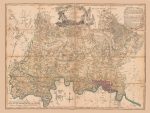
Rocque’s 1757 map of Middlesex places Georgian London within its surrounding county. The urban area is concentrated beside the Thames, leaving much of the sheet to roads, villages, woodland and estates north and west of the capital.
Map Details
- Original title: A Map of the County of Middlesex Reduced from an Actual Survey in Four Sheets
- Surveyor and publisher: John Rocque
- Edition: 1757
- Publication place: London; published by Rocque in the Strand
- Area shown: Middlesex, London and adjoining parts of neighbouring counties
- Format: Reduced county map with English and French titles
- Orientation: North at the top
- Print size: 22" × 30"
Before the suburbs joined together
Paddington, Kensington and Chelsea appear beside extensive open ground, while Pinner, Harrow and Barnet remain distinct settlements linked by country roads. The map gives familiar place names a different setting, making it possible to follow the older landscape beneath the later spread of London.
Surveying in the title cartouche
The ornamental title panel includes a measuring wheel and a surveying instrument on a tripod. These details connect the decoration directly with Rocque’s work as a land surveyor. The bilingual title also preserves his name as John Rocque in English and Jean Rocque in French.
Measuring Middlesex and London
The upper-right panel describes the size and parish divisions of Middlesex and gives separate measurements for London. It is a statement of how Rocque defined and measured the metropolis, rather than a description of today’s Greater London. The panel’s English and French text complements the bilingual title.
The river and the edge of the city
The Thames forms a strong coloured line across the southern part of the map. Around Kensington and Chelsea, the detailed roads and scattered buildings contrast with the coloured blocks of central London. Scale bars and border references add to the practical information, while the visible fold lines retain the appearance of the surviving historic sheet.


