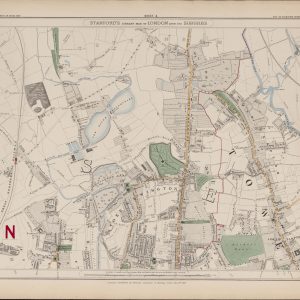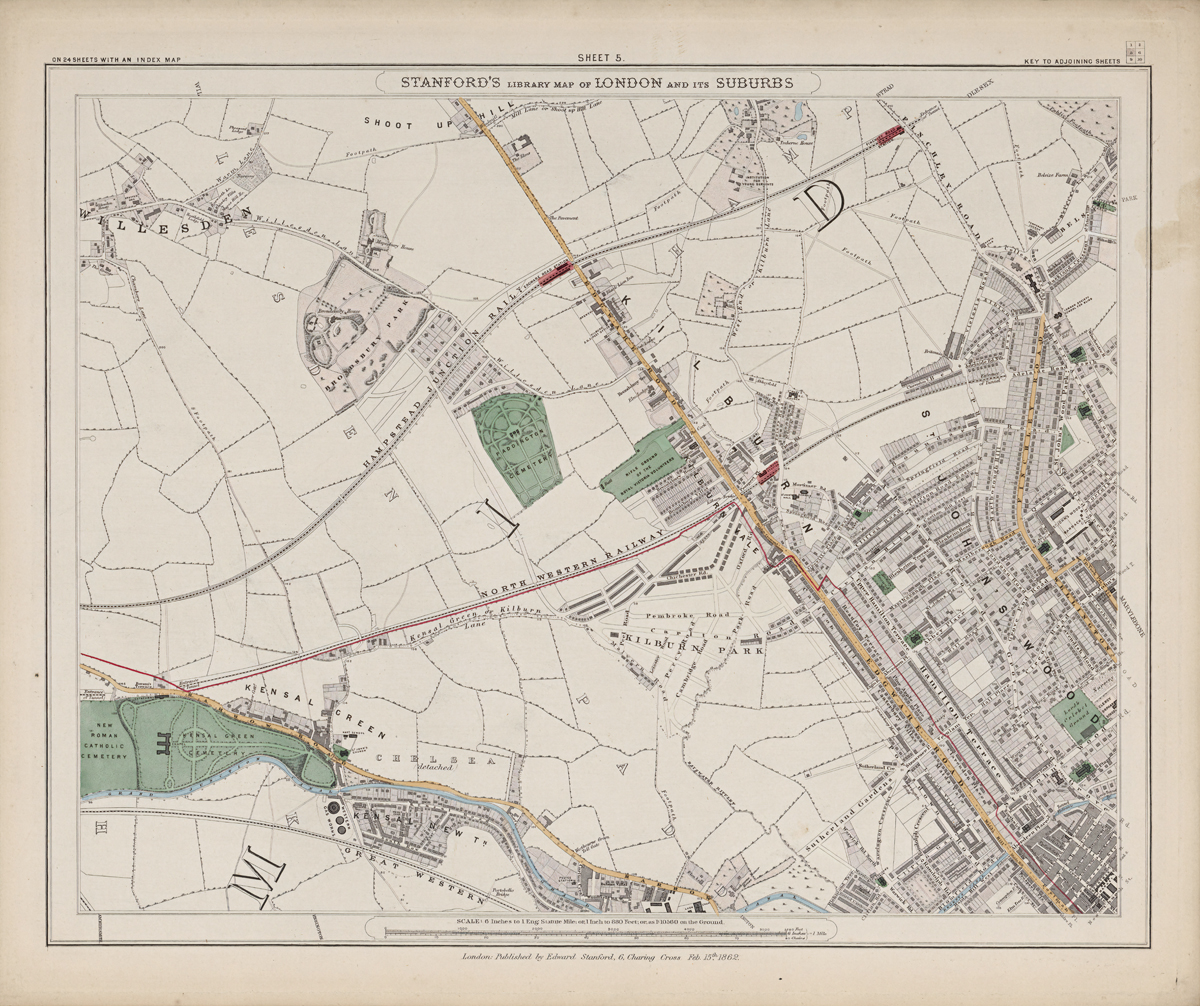
Sheet 5 of Stanford’s Library Map of London and Its Suburbs records north-west London in 1862, covering Kilburn, Brondesbury, Willesden, Kensal Green and adjoining districts. It shows a landscape on the edge of rapid change, where expanding streets and railway lines meet fields, farms, open ground and the extensive grounds of Kensal Green Cemetery.
Map Details
- Original title: Stanford’s Library Map of London and Its Suburbs
- Sheet: 5 of 24
- Publisher: Edward Stanford
- Published: London, 15 February 1862
- Scale: Six inches to one mile, approximately 1:10,560
- Area shown: Kilburn, Brondesbury, Willesden, Kensal Green, Harlesden and adjoining districts
- Orientation: North at the top
- Original appearance: Printed linework with hand-coloured roads, water, boundaries and open ground
Kilburn, Willesden and Kensal Green in 1862
Kilburn is already developing into a more closely built district, while Willesden and Harlesden remain much more open, divided by fields, lanes and scattered buildings. The contrast between these areas makes the sheet particularly useful for understanding the suburban expansion that would transform north-west London later in the nineteenth century.
Kensal Green Cemetery forms one of the most prominent landmarks on the sheet, while the surrounding road network and open ground show how sharply the developed edge of London still gave way to semi-rural country.
Railways, Canal and Suburban Growth
The railway network is a dominant feature, with the main north-western lines and associated sidings cutting across the district. Along the southern edge, the Grand Junction Canal provides another important transport route. Together these connections helped accelerate the later growth of Kilburn, Willesden and Kensal Green.
Postal and Administrative Detail
The large red NW belongs to the original map and marks the North Western postal district. Red boundary lines also preserve parish and local divisions from the period before the creation of the modern London boroughs.
Modern Postcode Coverage
The area shown broadly corresponds with parts of:
- NW6 – Kilburn, Brondesbury and the western edge of West Hampstead
- NW10 – Willesden, Harlesden and Kensal Green
- W9 – Maida Vale along the south-eastern edge
- W10 – Kensal Town and North Kensington along the southern margin
Modern postcode boundaries do not precisely follow the historic divisions shown on the map.