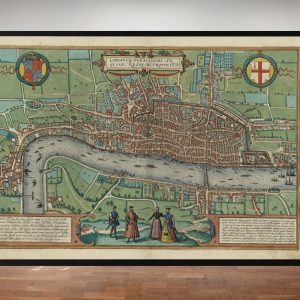
Thomas Kitchin’s A Map of the Countries Thirty Miles Round London, published in 1773, is one of the most revealing regional maps of Georgian London and its surroundings. Rather than treating the capital as a self-contained city, Kitchin places it at the centre of a much wider network of roads, villages, country estates and county landscapes.
Map Details
- Cartographer: Thomas Kitchin
- Date: 1773
- Original title: A Map of the Countries Thirty Miles Round London
- Associated publication: John Noorthouck’s A New History of London (1773)
- Coverage: Approximately thirty miles around London, from Berkshire to Canvey Island and from Bedfordshire to Sussex
- Features shown: Roads, parks, churches, windmills, watermills, country seats, political boundaries and relief
London Before the Great Suburban Expansion
In 1773 London was already one of Europe’s largest cities, but beyond the dense built-up centre the surrounding landscape remained a patchwork of separate villages, market towns, estates and farmland. Kitchin’s map preserves that world in remarkable detail.
Places that would later be absorbed into Greater London appear here as distinct settlements linked by roads and surrounded by open country. This makes the map especially valuable for understanding just how dramatic the expansion of London would become during the nineteenth and twentieth centuries.
Roads, Villages and Country Estates
The road network is one of the map’s strongest features. Routes radiate outward from London across Middlesex, Surrey, Kent, Essex, Hertfordshire, Berkshire and the neighbouring counties, connecting the capital with towns and villages throughout the region.
Alongside the roads are churches, parks, mills and the seats of gentlemen and noblemen. These details give the map a strongly social as well as geographical character. It is possible to read the landscape as a mixture of transport routes, local centres, landed estates and working countryside.
The Circuit of the Penny Post
The dotted line around London marking the Circuit of the Penny Post is one of the most unusual details on the map. The Penny Post had been founded in London in 1680 and provided a relatively inexpensive local postal service within the capital and its surrounding districts.
The representation of its circuit on a map dated 1773 is particularly noteworthy. Later commentary on postal cartography has suggested that the Penny Post circuit began appearing on London maps in the 1780s, making Kitchin’s depiction an unusually early example.
Thomas Kitchin and Georgian Cartography
Thomas Kitchin was one of the most prolific English cartographers and engravers of the eighteenth century. His work ranged from county maps and atlases to maps produced for histories, magazines and practical reference. This map demonstrates the combination of clarity and dense geographical information for which his work became known.
The association with John Noorthouck’s 1773 history of London is also significant. A regional map of this kind complemented a history of the city by showing the wider geographical setting in which London functioned.
Why This Map Stands Out
Many historic maps of London concentrate on the streets, wards and buildings of the city itself. Kitchin’s map is different. Its subject is London’s wider sphere of influence: the roads that fed into it, the villages and estates around it, and the communications network represented by the Penny Post.
That broader viewpoint makes it particularly rewarding for family history, local history and anyone interested in the landscape surrounding London before suburban development transformed it.
Print size: approximately 24" × 26". Supplied unframed.