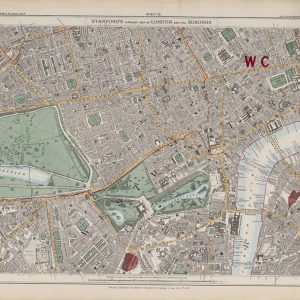
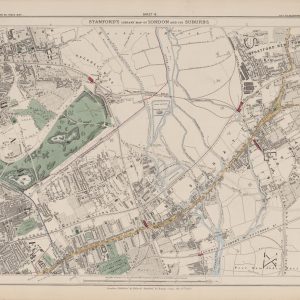
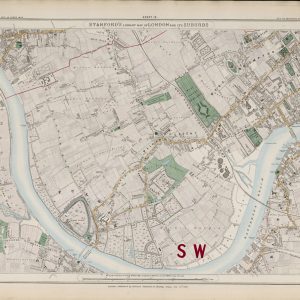
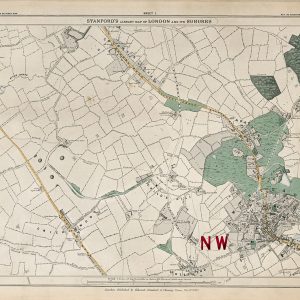
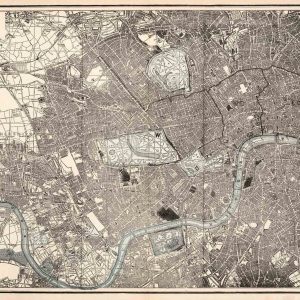
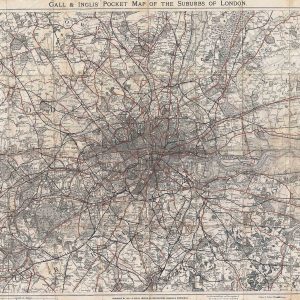
Bacon’s 1890 Traveller’s Map of London is a practical late-Victorian plan showing a broad sweep of the capital at a time of rapid suburban and transport growth.
Map Details
- Publisher: G. W. Bacon & Co.
- Date: 1890
- Map type: Traveller’s map of London
- Coverage: From West Kensington to the West India Docks, and from Hampstead south to Brixton and Camberwell
- Features: Streets, railways, stations, ferries, docks, parks and principal buildings
Late-Victorian London
By 1890 London had expanded far beyond the compact city shown on Georgian maps. Former villages had become urban districts, continuous streets spread across both sides of the Thames, and millions of journeys depended on an increasingly elaborate transport system.
Railways, Stations and the Underground
The railway network is one of the key historical features. Main-line routes enter London from every direction, while suburban services connect the centre with rapidly growing residential districts.
The date is particularly significant because 1890 also saw the opening of the City & South London Railway, the world’s first deep-level electric underground railway. Bacon’s map therefore sits at the dividing line between the early Victorian underground network and the tube system that would follow.
The Thames and the Docks
To the east, the West India Docks and other docklands underline London’s role as a global trading port. Ferries and river crossings show that the Thames remained a working transport artery as well as a geographical boundary.
Parks and the Shape of the City
Large parks remain conspicuous amid dense development. Their carefully drawn paths and boundaries make them useful visual anchors and show how important planned open space had become within the nineteenth-century metropolis.
G. W. Bacon & Co.
Bacon’s firm specialised in accessible commercial maps for travellers, households and reference use. This map’s combination of broad coverage and practical detail is typical of that approach and helps explain why Bacon became such a familiar name in British popular cartography.
Print size: approximately 24" × 31". Supplied unframed.