
VIEW AN INDEX OF THE FULL SERIES HERE
The Old London Map Company are pleased to offer this fine art reproduction sympathetically enhanced and digitalised from the original to a standard equalling museum quality. This map was originally published by Edward Stanford in 1872. Like the other sheets in the series, it originally formed part of a 24-sheet large-scale map depicting London and its surroundings during the late Victorian era. Now produced in individual editions so you can enjoy a finished piece featuring the particular area of interest within Victorian London.
Overview
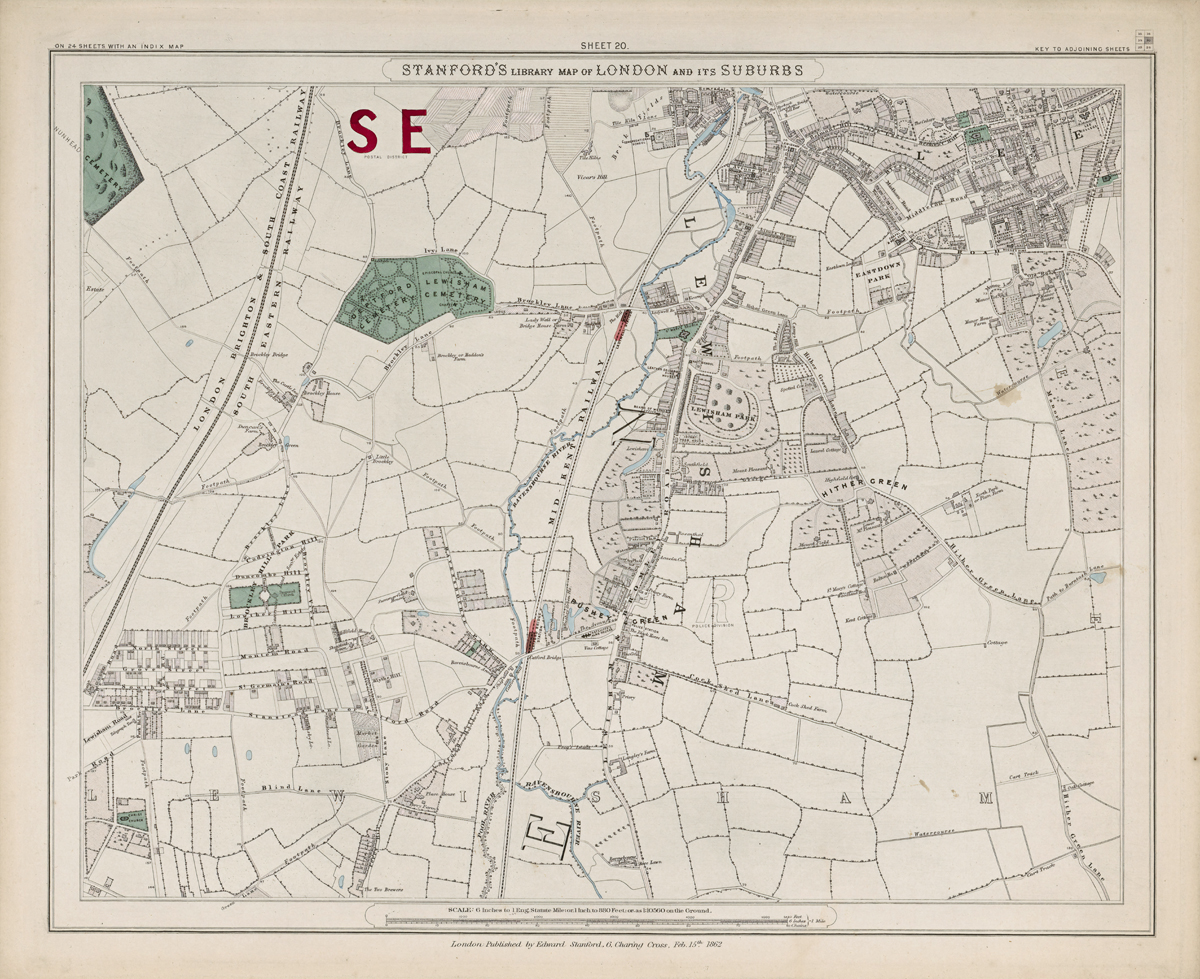
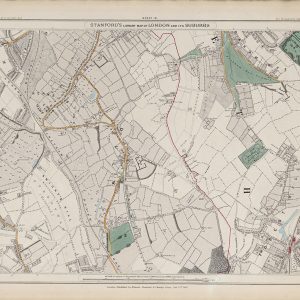
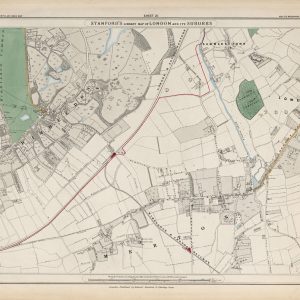
Sheet 20 shows the south-eastern fringes of London, focused on the Lewisham and Lee area and the approaches toward Eltham. In the early 1870s this region was largely rural with scattered villages, farms, and large private estates, though railway expansion was beginning to introduce suburban development.
Cartographic Details
- Fine engraved line work and subtle hand colouring typical of Stanford’s high-quality cartography.
• Parks, commons, and woodlands such as Manor House Gardens and Grove Park are shaded green.
• The River Ravensbourne and early railway lines are clearly marked, reflecting the growth of transport links.
Administrative and Postal Features
- The large red “S E” denotes the South Eastern postal district created during mid-19th-century postal reforms.
• Red boundary lines show parish and district divisions before the creation of the modern London boroughs.
Original Size
The complete Stanford’s Library Map measured about 9 × 12 feet (approximately 2.7 × 3.7 m) when all 24 sheets were assembled. Each individual sheet, including Sheet 1, was printed on paper roughly 18 × 24 inches (about 46 × 61 cm) which we supply as our Medium size but due to the quality of our scanning process we are also able to offer a larger edition at 24 x 29 inches (about 61 × 73.5 cm) printed on conservation grade paper.
Modern Postcode Coverage
Today this south-eastern area of London corresponds largely to the following Royal Mail postcode districts:
• SE12 – Lee, Grove Park
• SE13 – Lewisham, Hither Green
• SE9 – Eltham (northern parts)
• SE6 – Catford (western edge)
• BR1 – Bromley (south-eastern fringe)
Twenty Major Places Shown on the Map
Notable locations visible include:
1. Lewisham Station
2. St Mary’s Church, Lewisham
3. Hither Green (then open farmland with scattered houses)
4. Manor House, Lee
5. Manor House Gardens
6. River Ravensbourne
7. Lee Station (early railway stop)
8. Grove Park (later development site)
9. Horn Park (estate grounds)
10. Blackheath Park (north-west corner)
11. Eltham Road area
12. St Margaret’s Church, Lee
13. Catford Bridge (west edge)
14. Ladywell Fields (northern fringe)
15. Southend Village (south-east corner)
16. Burnt Ash Farm
17. Lee Green
18. Lewisham High Road district
19. Hither Green Lane
20. Chinbrook Meadows (future park area)
Twenty Major Roads and Thoroughfares Shown
Prominent streets and routes include:
1. Lewisham High Street
2. Lee High Road
3. Eltham Road
4. Bromley Road
5. Manor Lane
6. Hither Green Lane
7. Burnt Ash Hill
8. Burnt Ash Road
9. Baring Road
10. St Mildred’s Road
11. Lee Road
12. Lee Park
13. Belmont Hill
14. Clarendon Road (later renamed sections)
15. Blackheath Road (north-west edge)
16. Springbank Road
17. Southend Lane
18. Rushey Green (west edge)
19. Manor Park Road
20. Grove Park Road
In summary, Sheet 20 offers a snapshot of the rural landscapes and emerging suburban centres of south-east London in the early 1870s, showcasing the balance of farmland, estates, and new transport connections that would soon transform the district.